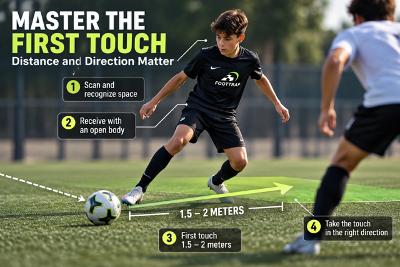
A great first touch is not simply about controlling the ball.
It is about controlling the ball into the right space for your next action.
At FootTrap Soccer Consulting, we want young players to understand that the first touch should have purpose, distance and direction.
The 1.5–2 Meter First-Touch Concept
When a player has enough space, a useful target for a positive first touch is approximately 1.5–2 meters (5–6.5 feet) away from the body.
Why?
Because a touch that stays too close can force the player to take another unnecessary touch before passing, dribbling or shooting.
A touch that travels too far can become difficult to control and may allow a defender to win the ball.
The goal is to find the distance that allows the player to move naturally into the next action without breaking stride.
However, 1.5–2 meters is a training reference, not a fixed rule. Under heavy pressure, the best first touch may need to be much shorter. In open space, it may even be longer.
Direction Is Just as Important as Distance
Players should not think:
“Can I control the ball?”
They should think:
“Where should my first touch take me?”
A quality first touch can:
● Take the player away from pressure.
● Move the ball into open space.
● Set up the next pass.
● Prepare the body for a shot.
● Allow the player to accelerate forward.
● Help eliminate a defender without needing a dribble move.
For example, if pressure is coming from the player’s left side, the first touch may need to travel toward the right and into available space.
If a striker receives between the lines with space to turn, the first touch can take the ball forward and immediately put the defense under pressure.
The First Touch Starts Before the Ball Arrives
This is one of the most important lessons for young players.
A good first touch actually begins before receiving the ball.
The player should:
Scan → Recognize pressure → Open the body → Decide the next action → Receive into space
Scanning tells the player where the space is.
Body orientation makes that space easier to attack.
The first touch then connects the player’s decision to the next action.
Don’t Stop the Ball — Move the Ball
Young players are often taught simply to “control the ball.”
But as players develop, we want them to progress from stopping the ball to moving the ball with their first touch.
Instead of:
Receive → Stop → Look → Decide → Move
We want:
Scan → Decide → Receive into space → Play
That difference can save valuable time.
At higher levels, even one second can determine whether a player has space to play forward or immediately comes under pressure.
A Simple Training Challenge
Place a receiving player in the middle with different gates positioned around them.
Before the pass arrives, call a color or direction—or allow the player to scan and identify the free gate.
The player’s challenge is to receive with an open body and use the first touch toward the available space, aiming for an appropriate distance that allows the next action to happen quickly.
As players improve, add passive and then active pressure.
Now the exercise is no longer just about technique.
It develops scanning, awareness, body orientation, first-touch quality and decision-making together.
FootTrap Coaching Point
Your first touch should solve a problem.
Don’t take a touch simply to control the ball.
Take a touch that creates space, time and an advantage for your next action.
Scan it. Open up. Touch into space. Play forward.
FootTrap Soccer Consulting — Developing technique, game understanding and smarter decision-making in young players.