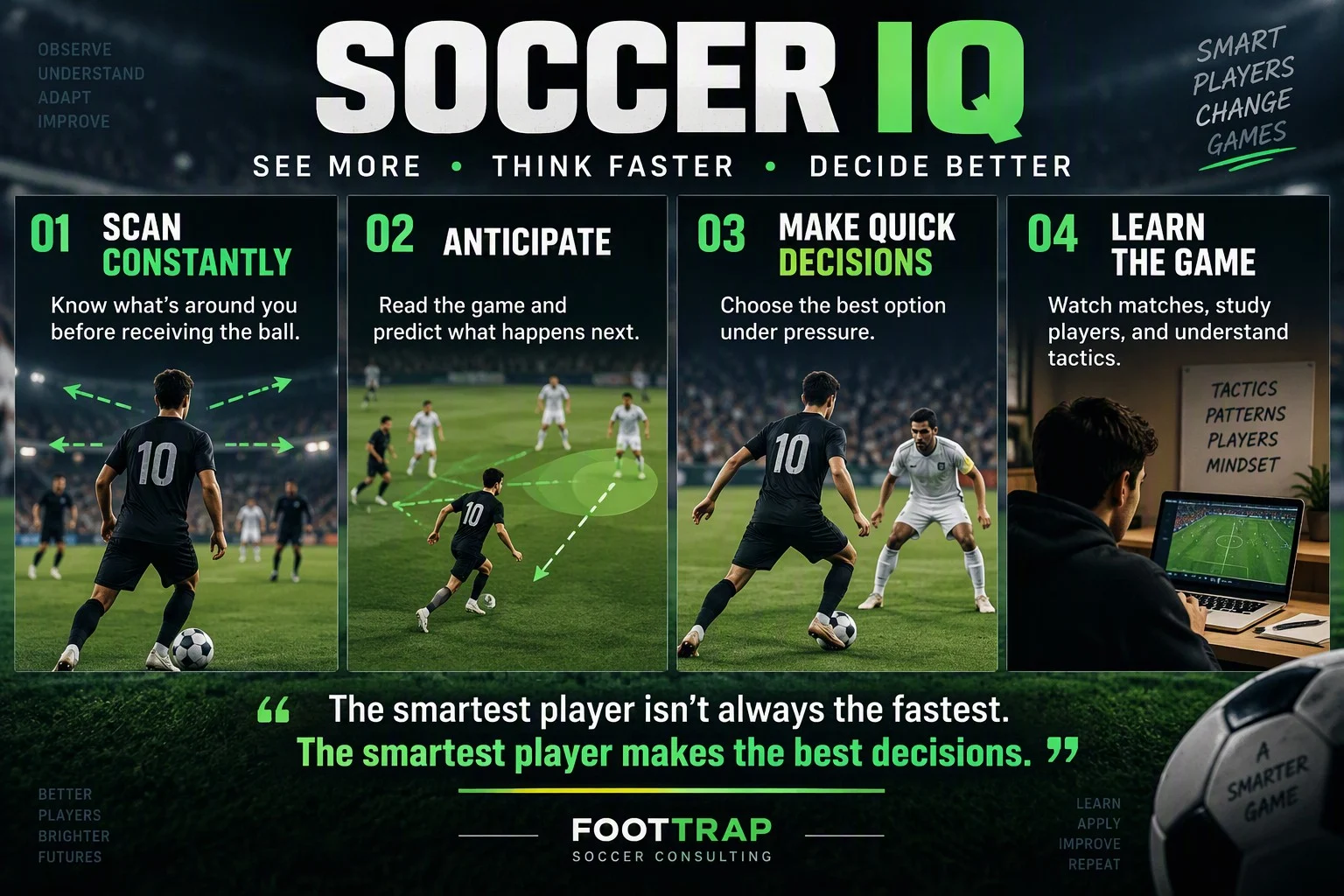
How to Develop Soccer IQ: Training the Mind Before the Feet
Many coaches spend hours correcting a player's technique, fitness, and physical execution. While those elements are important, the legendary Johan Cruyff believed they were only part of the equation. What truly separated elite players from average ones was not how fast they ran, but how fast they thought.
During his time influencing the development of players at La Masia, Cruyff was known for constantly stopping training sessions. Rather than focusing solely on a misplaced pass or poor first touch, he would challenge players to explain their decisions. Why did you pass there? What options did you see? What were you trying to achieve?
Cruyff wasn't just correcting the technical. He was correcting the cognitive.
He famously said:
"Soccer is a game played with the head. The feet are only a tool to execute what the head has already decided."
That philosophy remains one of the most important lessons in player development today.
What Is Soccer IQ?
Soccer IQ is the speed and precision with which a player processes information on the field and turns that information into effective decisions.
Many people confuse Soccer IQ with reaction speed, but they are not the same thing.
Reaction speed occurs after something happens. A player reacts to an opponent's movement, a loose ball, or a pass.
Soccer IQ happens before the play unfolds.
Players with high Soccer IQ are constantly scanning the field, collecting information, recognizing patterns, and predicting what is about to happen. By the time the moment arrives, they have already made their decision.
In simple terms, a player with good Soccer IQ doesn't react to the game. They anticipate it.
Why Soccer IQ Matters
Athleticism can give a player an advantage, but intelligence allows them to maximize every action.
A physically gifted player may win a race to the ball. A smart player positions themselves so they never have to race at all.
Cruyff often emphasized that the player who thinks faster will always have an advantage over the player who simply runs faster. When players process information quickly, they:
Create more time and space for themselves.
Make better passing decisions.
Read opponents' intentions.
Arrive in the correct position earlier.
Conserve energy through efficient movement.
Influence the game even when they are not touching the ball.
At higher levels of soccer, where technical ability is often similar among players, decision-making becomes the true separator.
How to Train Soccer IQ
1. Ask Questions, Don't Give Answers
One of Cruyff's most effective methods was questioning players.
Instead of telling a player what they did wrong, ask:
What did you see?
What options were available?
Why did you choose that action?
What might have been a better solution?
This forces players to think about the game instead of simply following instructions. The goal is to develop independent decision-makers who can solve problems under pressure.
2. Encourage Constant Scanning
Elite players scan their surroundings before receiving the ball.
They gather information about:
Opponent positions
Teammate movement
Available space
Potential threats
The more information a player collects before receiving possession, the faster and more accurately they can make a decision.
As Xavi once explained, the game becomes easier because he already knows where the next pass will go before the ball arrives.
3. Use Small-Sided Games
Small-sided games create more decisions in less time.
Players are constantly exposed to:
These environments accelerate learning because players repeatedly experience game-like scenarios and must find solutions on their own.
4. Train Perception Before Technique
Traditional training often teaches a skill first and asks players to make decisions afterward.
A better approach is to create situations where players must first recognize the problem and then execute the technique required to solve it.
The game is not about performing techniques. It is about using techniques at the right moment.
5. Analyze the Game
Watching soccer can be a powerful learning tool when done correctly.
Instead of following the ball, players should observe:
Movement off the ball
Team shape
Positioning
Pressing triggers
Space creation
Learning to understand the game tactically helps players recognize patterns they can later apply on the field.
The Difference Between Smart and Reactive Players
Imagine two midfielders.
The first sees pressure coming and reacts once the defender arrives. The second scans the field before receiving the ball, knows where the pressure will come from, and already has a solution planned.
Both players may appear technically similar.
The difference is that one reacts while the other anticipates.
That anticipation is Soccer IQ.
Final Thoughts
Developing Soccer IQ is not about memorizing tactics. It is about teaching players to see the game, understand situations, and make better decisions before the action occurs.
Johan Cruyff understood that great soccer is played first in the mind and only then through the feet. While many coaches focus on correcting physical and technical mistakes, the greatest development opportunities often lie in improving the player's thinking process.
The smartest players are not always the fastest, strongest, or most athletic. They are the ones who consistently arrive at the right place, at the right time, with the right decision already made.
In the end, soccer is not won by the fastest feet. It is won by the fastest minds.
At FootTrap Soccer Consulting, we believe the best players are not just technically gifted but intellectually advanced, and our training methodology is designed to develop players who can think faster, anticipate better, and make smarter decisions before the play unfolds. If you want to help your player unlock elite Soccer IQ and gain a competitive advantage on the field, contact FootTrap Soccer Consulting to learn more about our player development programs.