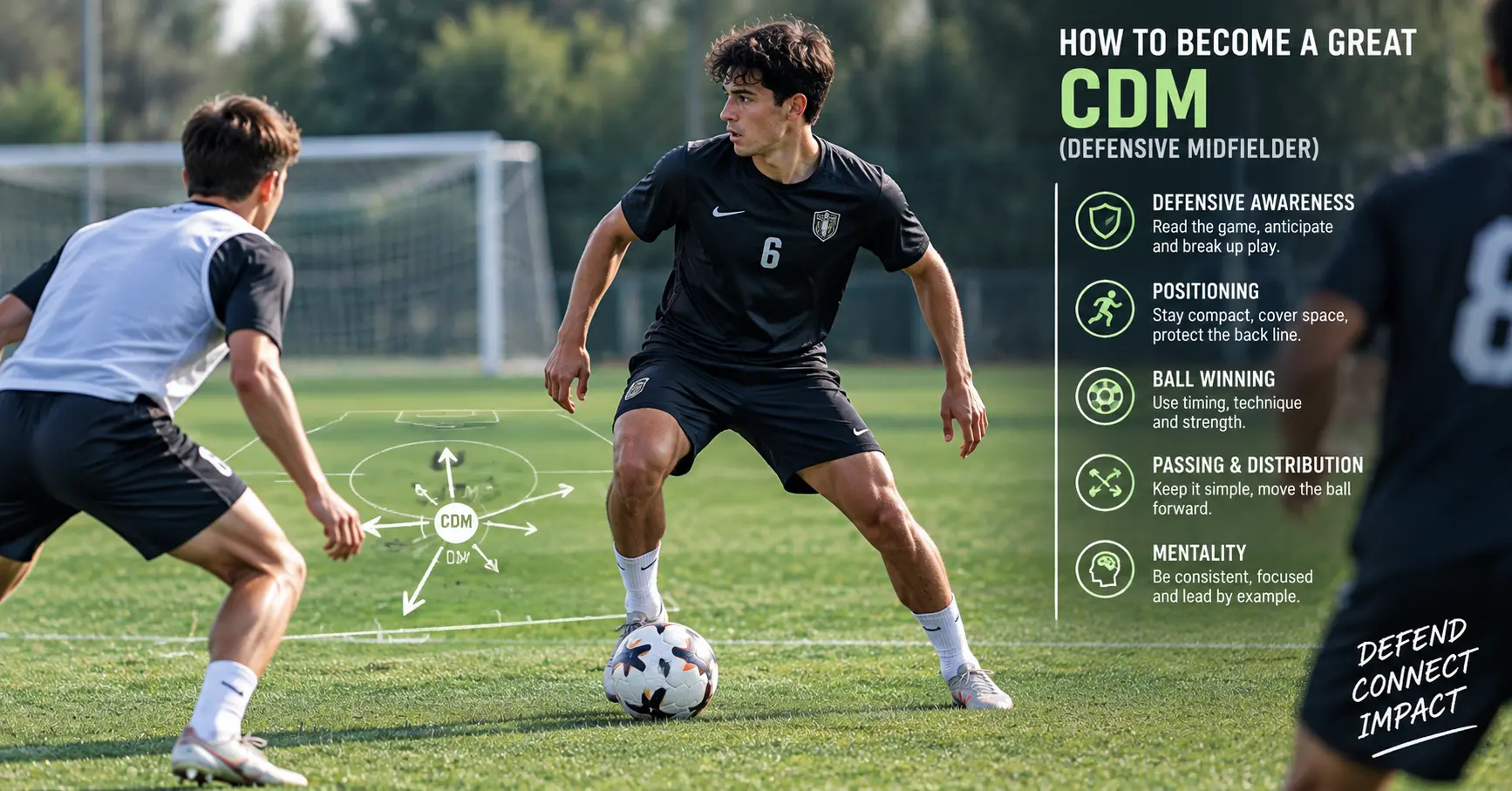
Watch a top-level No. 6 for just a few minutes, and the pattern becomes obvious: she’s rarely scrambling, rarely caught out of position, rarely surprised by where the next pass goes. That kind of composure is exactly what good soccer player development looks like at this position — a great CDM isn’t just a ball winner. The best defensive midfielders read the game, control the tempo, protect their defense, and connect the entire team.
Below are the seven qualities that separate an elite CDM from a player who simply wins tackles.
1. Game Intelligence
Elite CDMs anticipate danger before it happens, read passing lanes before the ball is played, and think two steps ahead of the current phase of play. This is less about reacting quickly and more about recognizing patterns early enough that the “reaction” looks effortless from the outside.
2. Scanning and Awareness
Checking over both shoulders constantly, before the ball arrives, is non-negotiable at this position. A good CDM already knows her next action before her first touch, because she’s gathered the information she needs in advance rather than figuring it out under pressure.
3. Defensive Positioning
A strong No. 6 protects central spaces, stays connected to the center backs, and prevents opponents from turning in dangerous areas. Good positioning often prevents a problem before it starts, which is a quieter, less visible skill than a last-ditch tackle, but far more valuable over 90 minutes.
4. First Touch and Body Orientation
Receiving on the half-turn, opening the hips, and positioning the body to play forward are core habits for this role. This connects directly to how opening the hips changes a player’s options on the ball — a CDM who receives square to the passer limits her own options immediately, while one who receives at an angle can see and use far more of the field.
5. Passing and Decision-Making
Knowing when to play simple, switch the point of attack, break lines with a forward pass, or simply control possession is what separates a CDM who dictates tempo from one who just moves the ball along. This decision-making only works well when it’s paired with the scanning and body orientation habits above — space and time shape a player’s decision-making at every position, but especially at CDM, where the tempo of the whole team often runs through this role.
6. Winning Duels and Second Balls
Being aggressive, disciplined, and intelligent in challenges matters, but winning the ball is only half the job. Knowing what to do immediately afterward, whether that’s playing forward, resetting possession, or shielding the ball under renewed pressure, is just as essential as winning the duel itself.
7. Leadership and Communication
A great CDM organizes teammates, communicates constantly, and helps maintain balance during transitions. This role often sits at the center of the team both physically and functionally, which makes clear, consistent communication part of the job, not an optional extra.
Why the Best CDMs Don’t Chase the Game
The best defensive midfielders don’t chase the game — they anticipate it. Studying players like Rodri, Sergio Busquets, and N’Golo Kanté makes this visible: watch how their positioning, awareness, and decisions make difficult situations look simple, almost unremarkable, because they’ve already solved the problem before it became obvious to everyone else watching.
Frequently Asked Questions
What’s the most important skill for a CDM?
Game intelligence tends to matter most, since it underlies everything else on this list — positioning, scanning, and decision-making all depend on a player’s ability to read the game and anticipate what happens next.
How can a young player start training to play CDM?
Scanning and body orientation are good starting points, since they’re trainable habits that don’t require elite physical attributes. A player who develops these early has a foundation the rest of the position can be built on.
Does a CDM need to be a strong tackler?
Tackling matters, but it’s not the defining skill. Positioning well enough to prevent a dangerous pass or turn in the first place is often more valuable than winning a last-ditch challenge after the fact.
Can smaller or less physical players succeed at CDM?
Yes. Game intelligence, positioning, and decision-making can compensate significantly for a lack of physical dominance, which is part of why players like Busquets have thrived at the position without relying primarily on physicality.
Final Thoughts
Train your brain as much as your feet. The qualities that define a great CDM, game intelligence, scanning, positioning, body orientation, passing, duel-winning, and leadership, work together, not in isolation. A player who develops all seven doesn’t just win the ball back. She controls the game around her.
If you’d like a professional assessment of your player’s positional development, contact FootTrap Soccer Consulting to get started.